






Tung Wah College’s “Hong Kong Working Caregivers’ Mental Well-being Survey” Research Findings Workplace support is key to helping working caregivers balance work and caregiving
05/11/2026
Hong Kong’s population continues to age. According to the Census and Statistics Department, as of mid-2026, the population aged 65 or above exceeded 1.8 million, accounting for approximately one-quarter of the total population. Around 80% of older people with long-term care needs are cared for by family members, and one in three of these caregivers is employed full-time. In addition, Hong Kong has an estimated 600,000 people with physical or intellectual disabilities, most of whom are cared for by family members. One in six of these caregivers also holds a job while providing care.
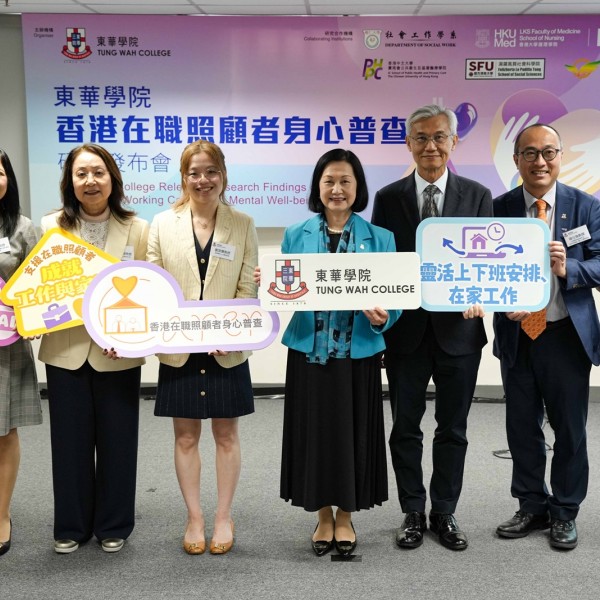
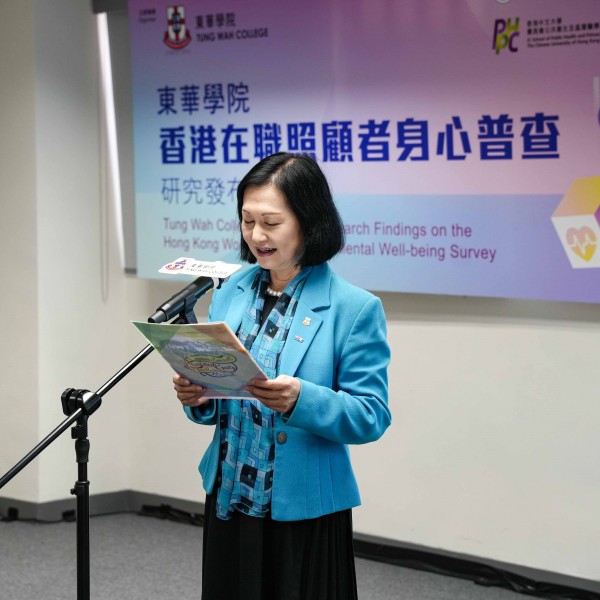
Balancing work and caregiving have become an increasingly important social issue. Today, research team comprising academics from Tung Wah College (TWC) and various local tertiary institutions announced the findings of “Hong Kong Working Caregivers’ Mental Well-being Survey”.
The research team surveyed nearly 600 working caregivers to examine their physical and mental well-being. The findings indicate that work and caregiving can be mutually enriching rather than inherently conflicting. When workplaces provide “caregiver-friendly measures”, these arrangements can alleviate caregiving burden and reduce depressive symptoms. The study also found that community support services often operate during standard working hours, making it difficult for working caregivers to get timely assistance. Existing service models therefore urgently need to be redesigned and enhanced to better meet their needs.
Nearly 60% report a heavy caregiving burden; over 80% find caregiving meaningful
The study was led by Professor Bobo Lau of the School of Arts and Humanities at TWC and funded by the University Grants Committee’s Faculty Development Scheme.
The study was conducted in two phases. In the first phase, an online questionnaire was distributed in 2025 through local elderly-care and rehabilitation organisations and caregiver support groups. It collected responses from 566 working caregivers aged 21 to 73, including full-time, part-time and self-employed individuals.
In the second phase, in-depth interviews were conducted with 30 respondents to better understand their practical experiences and needs in balancing work and caregiving. The respondents provided unpaid care for family members or older relatives whose average age was 70. Most of these care recipients were living with chronic illnesses (60%) or disabilities (27%).
The survey found that 59% of respondents reported a heavy caregiving burden, while 82% said caregiving had brought them gains and gratification. These findings suggest that work and caregiving are not necessarily in conflict: with adequate support, working caregivers can still find meaning and fulfilment in their caregiving role.
The caregiver-friendly workplace measures most commonly used by respondents were flexible working hours (33%), part-time work (17%), working from home (13%) and compressed working weeks (12%). Flexible working hours and working from home were found to be the most effective measures for easing caregiving burden and psychological stress. Nearly 70% of respondents said their employers offered at least one caregiver-friendly measure. However, more than half of respondents had never used such measures. This limited uptake may reflect difficulties in applying for these arrangements, workplace culture or a lack of awareness of the support available.
Use of caregiver-friendly workplace measures linked to fewer depressive symptoms and a lower caregiving burden
Respondents who used caregiver-friendly workplace measures reported fewer depressive symptoms and a lower caregiving burden than those who did not. Among those who had used these measures, 45% had depression scores above the average, compared with 55% of those who had not—a difference of 10 percentage points.
Similarly, 45% of respondents who had used these measures had caregiving burden scores above the average, compared with 55% of those who had not—a difference of 10 percentage points. The research team noted that these findings highlight the potential benefits of workplace support for caregivers’ mental well-being and its role in easing caregiving-related stress. More active promotion of these arrangements, together with encouragement to use them, could improve employee well-being and foster a more caregiver-friendly workplace culture.
Support services available mainly during working hours leave working caregivers underserved
During the in-depth interviews, several working caregivers described frequently having to deal with unexpected family situations, accompany relatives to medical appointments or provide temporary care during working hours. Flexible working arrangements and the option to take leave in hourly increments would help them manage these responsibilities with less disruption to their work. Such arrangements would also help them maintain their livelihoods while easing stress and financial pressure.
The study also found that several caregiver support services operate during standard working hours, making them difficult for working caregivers to access. For example, some elderly day-care services do not cover the full working day, while emotional support and information services may be unavailable outside office hours. These gaps can prevent working caregivers from receiving timely assistance. The research team emphasised that Hong Kong does not lack caregiver support resources; rather, existing services are not sufficiently tailored to working caregivers’ daily circumstances.
Businesses, communities and families can work together to build a caregiver-friendly ecosystem
Professor Bobo Lau of the School of Arts and Humanities at TWC, who led the research project, said: “As Hong Kong enters a ‘super-aged society’, supporting caregivers is an issue that society cannot afford to overlook. Public discussion has often focused on the difficulties working caregivers face in balancing employment and care responsibilities. Our research shows that, with appropriate support, these two roles can coexist and reinforce each other. At the corporate level, we recommend that companies continue to promote flexible working hours, work-from-home arrangements and more flexible leave policies. At the social welfare service level, we recommend extending day-service hours and making emotional support, information and other support services available beyond standard office hours. More flexible and convenient private elderly-care services could help meet families’ diverse care needs while supporting the silver economy. Technology-based services and platforms should also be introduced to help family members better recognise the caregiver role and strengthen their capacity to provide care.”
Golden Age Foundation (GAF), the research partner, has long promoted caregiver support, addressed care needs and pressures arising from population ageing, and encouraged businesses to adopt caregiver-friendly measures. The research team and GAF emphasised that caregiving responsibilities should not fall on just a few family members. Instead, caregiving should be recognised as a social role: caregivers should be identifiable, able to receive training, supported in building experience and able to access assistance.
The team recommended promoting the concept of a “universal caregiver”, in which all family members share caregiving responsibilities to ease the burden on primary caregivers. Support networks should also include neighbours, colleagues, professional service providers and technology platforms. Through collaboration among the Government, businesses and the social welfare sector, Hong Kong can gradually build a care network for all and a caregiver-friendly ecosystem that is diverse, inclusive, sustainable and connected across generations.
Research team members:
- Professor Bobo Lau, Professor, School of Arts and Humanities, Tung Wah College
- Professor Steve Fong, Head of Department and Professor of Practice, Department of Social Work, Hong Kong Shue Yan University
- Professor Doris Yu, Professor, LKS Faculty of Medicine School of Nursing, The University of Hong Kong
- Professor Crystal Chan, Research Assistant Professor, JC School of Public Health and Primary Care, The Chinese University of Hong Kong
- Dr. Florence Fong, Assistant Professor, Felizberta Lo Padilla Tong School of Social Sciences, Saint Francis University
- Professor Rebecca Choy-Yung, Founding Chair, Golden Age Foundation